Ripple Director Confirms XRP Ledger Will Power Post-Trade Infrastructure for All Hidden Road Prime Brokerage Services
Ripple integrates XRPL into Hidden Road’s post-trade systems, unlocking institutional potential and fueling XRP price speculation.
Ripple’s Bold Move: XRPL Enters Prime Brokerage Infrastructure
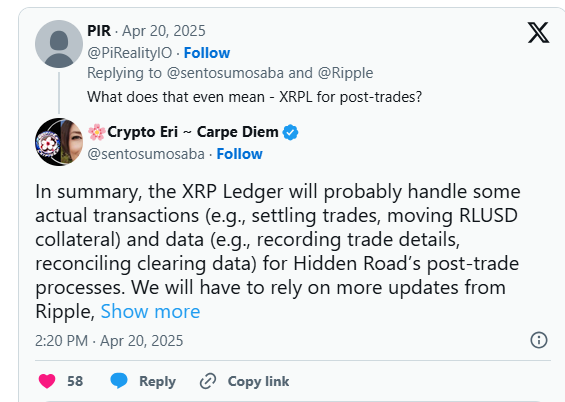
Ripple has taken a major strategic leap with its acquisition of Hidden Road, a prominent prime brokerage firm that processes a staggering $3 trillion in annual transaction volume. According to Cassie Craddock, Ripple's Managing Director for the UK and Europe, the XRP Ledger (XRPL) is set to become the foundation for all of Hidden Road’s post-trade infrastructure. This development could have far-reaching implications for the broader crypto market, especially as institutional clients look for scalable, secure blockchain solutions. Craddock emphasized that Ripple’s native stablecoin, RLUSD, will serve as collateral within this new framework, bridging digital assets with traditional finance systems. This integration aims to solve long-standing inefficiencies plaguing traditional post-trade operations—such as delayed settlements and high processing costs. Ripple is strategically positioning XRPL as a core part of its digital asset services for financial institutions worldwide.How XRPL Streamlines Post-Trade Operations for Hidden Road
The XRPL's integration into Hidden Road's back-end systems marks a key milestone in crypto's evolution into institutional-grade infrastructure. Post-trade activities—which include the confirmation, clearing, and settlement of trades—have traditionally relied on outdated systems prone to latency and human error. Ripple’s deployment of XRPL for these functions is expected to deliver higher speed, transparency, and cost-efficiency for financial institutions. Craddock highlighted that the use of RLUSD on the XRP Ledger would further simplify settlement and custody processes. This allows for near-instant finality and a smoother flow of funds and information across platforms. With over 300 institutional clients already engaged through Hidden Road, the demand for robust post-trade systems has never been higher. Ripple's solution offers an innovative, blockchain-native way to meet that demand, reducing friction in multi-asset operations across fiat and digital currencies.Ripple’s Institutional Play: Access to 300 New Clients
With the Hidden Road acquisition, Ripple has secured more than just infrastructure—it has gained access to a “captive audience” of 300 institutional clients, according to Craddock. These firms are increasingly seeking reliable, scalable ways to manage digital asset exposure and post-trade workflows. Ripple plans to offer them not only payment and custody services but also the backbone to run real-time settlements through XRPL. This access significantly amplifies the reach and adoption potential of the XRP Ledger, enhancing its reputation as a blockchain built for enterprise-grade applications. It’s also a notable move in Ripple's broader strategy to dominate in the convergence of TradFi and decentralized finance. These institutions, previously limited by legacy systems, now have the opportunity to adopt a flexible and proven crypto price infrastructure. As banks and trading firms pivot toward tokenized assets and blockchain-led settlement models, Ripple stands ready with a comprehensive toolkit. The benefits include improved transparency, cost reduction, and superior liquidity management—a trifecta that’s tough to match with traditional rails.XRP Ledger’s Institutional Utility: What It Means for Coin Value
A central question on the minds of XRP holders and crypto analysts is what this massive integration could mean for the coin’s value. XRPL powering $3 trillion in annual transactions, even if only a portion of it leverages XRP as a bridge asset, could potentially create significant demand. Although nothing is guaranteed, increased utility often translates into upward price pressure in the long term. A speculative AI analysis recently suggested that XRP could reach as high as $28.55 if it became central to processing the full transaction volume—a 13x gain from current levels. However, such projections assume best-case scenarios where institutions fully adopt XRP for settlements and not just the ledger’s architecture. Even if real-world adoption falls short of this projection, the increased visibility and utility still serve to bolster XRP’s profile in the crypto market. Craddock’s comments make it clear that Ripple is playing the long game, focusing on tangible use cases for institutional finance. In this context, XRP isn’t just a speculative token—it’s part of a broader solution aimed at transforming financial plumbing.